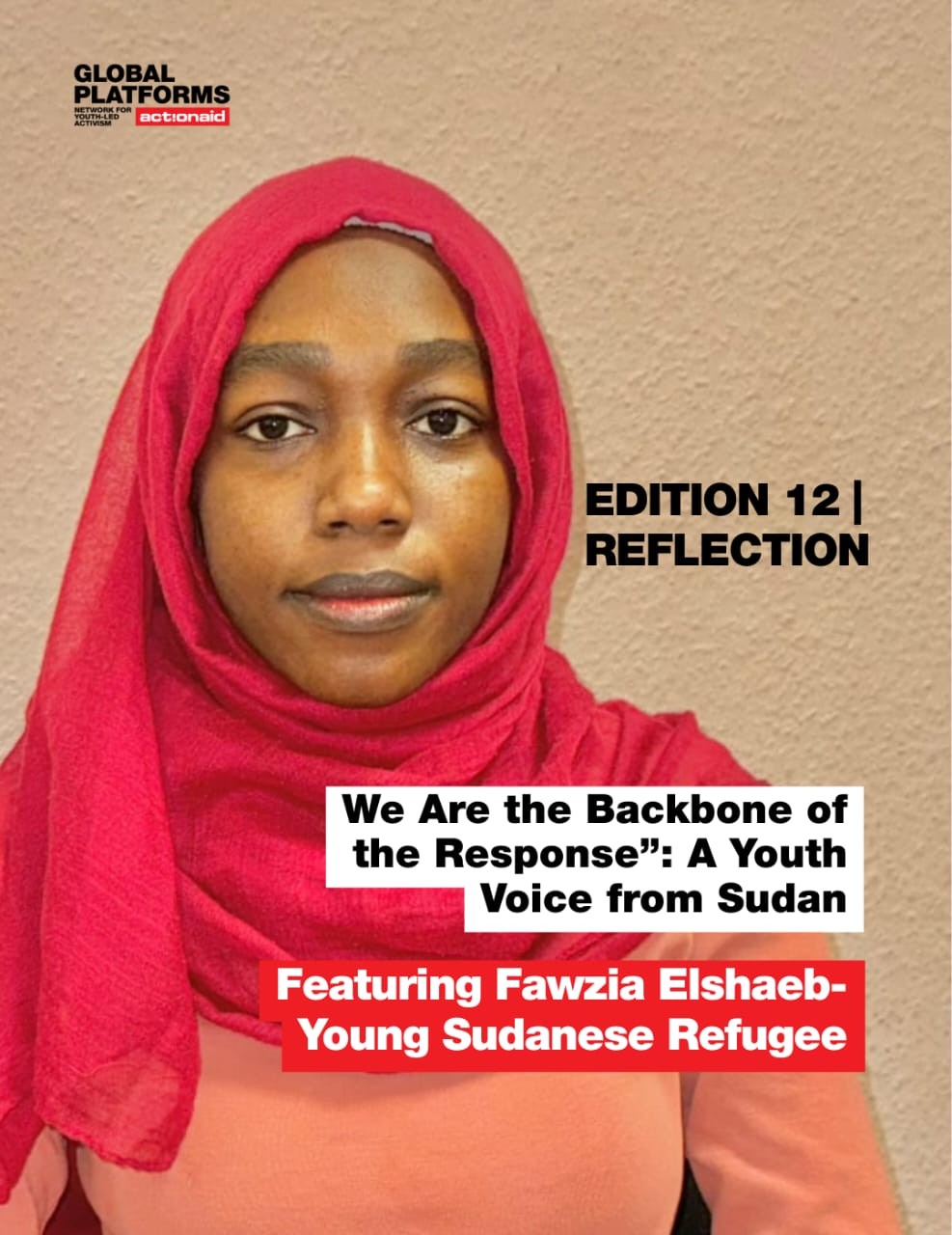
This week, we feature Fawzia Elshaeb, a Sudanese youth leader currently serving as a Board Member of the National Youth Mechanism for Child Protection.

Featuring Fawzia Elshaeb- Young Sudanese Refugee
When we speak about humanitarian crises, numbers often dominate the headlines.
But behind those numbers are young people carrying communities on their shoulders.
This week, we feature Fawzia Elshaeb, a Sudanese youth leader currently serving as a Board Member of the National Youth Mechanism for Child Protection.
Fawzia’s journey into the humanitarian space has not been linear. She began her work in Sudan as a volunteer supporting community initiatives and youth-led responses. However, ongoing security conditions and restrictions on humanitarian work eventually forced her to leave the country. Today, like many Sudanese youth working across borders, she continues to support community initiatives and amplify youth voices despite displacement.
“What Is Happening Cannot Be Fully Described”
Since the outbreak of war on 15 April 2023 in Khartoum, Sudan has experienced what Fawzia describes as a comprehensive collapse of basic life systems.
Education, healthcare, clean water, electricity, telecommunications and even the banking system have deteriorated.
Approximately 80% of health facilities have gone out of service due to shelling and attacks. Schools and universities have been burned or militarised. Civilians have been forcibly displaced, robbed, detained, tortured, and in some cases killed at checkpoints.
She speaks of:
- Women and girls facing horrific sexual violence
- Pregnant women without access to primary healthcare
- Survivors of violence without psychosocial support
- Children crying from hunger
- Infants without milk
- People relying on wild plants and insects for food
- Entire cities under siege
- Famine declared in parts of Darfur and South Kordofan
“If I told you words are enough to describe the humanitarian situation, I would not be honest,” she says.What the world does not fully see, she explains, is the scale of systemic collapse – and the erosion of international humanitarian law.
Youth: Fuel for War, Backbone of Survival
In Fawzia’s view, youth are among the most affected groups.
Politically, millions of young Sudanese have been drawn into the conflict. Some have been detained, persecuted, or silenced for opposing war and hate speech. Others have been killed or imprisoned.
Economically, youth have lost jobs, income, and educational pathways. Universities closed. Documentation lost. Students forced into exile, navigating new education systems and language barriers.
Security-wise, young people face checkpoints, arbitrary detention, and forced disappearance.
And yet
Youth are also the backbone of Sudan’s community response.
With nearly nine million displaced, young people stepped in immediately:
- Establishing emergency rooms and coordination hubs
- Opening shelters
- Creating community kitchens and food initiatives
- Organising local resource distribution
- Coordinating across regions
- Mobilising diaspora funding
- Engaging African Union, IGAD, and UN mediation platforms
Youth networks have even received international recognition, including the Rafto Prize and Global Pluralism Award.
“Youth do not only respond to humanitarian needs,” she explains. “They also seek to be part of the political solution and peace-making.”
Leaders – But Not Recognised as Such
Despite this, youth in Sudan are rarely treated as leaders.
“They are seen as implementers or volunteers,” Fawzia says, “but in reality, they are essential partners in any successful community response.”
Volunteers have sacrificed personal futures to support others. Yet recognition, institutional support, funding, and decision-making space remain limited.
What Is Missing in the Response?
According to Fawzia, the humanitarian response urgently needs:
- Direct financial and logistical support
- Training and institutional capacity building
- Smart partnerships with international organisations
- Inclusion of women and youth in decision-making at every stage
- Reduced bureaucratic procedures
- Support for community recovery, not only temporary projects
Trust between local actors and international stakeholders must be strengthened.
What Real Solidarity Looks Like
For her, solidarity means:
- Protection for frontline youth responders
- Direct funding with fewer intermediaries
- Long-term flexible support
- Investment in education and return to schools
- Psychosocial support
- Support for community resilience, not dependency
The Humanitarian Reset – Through a Sudanese Lens
When asked about the “Humanitarian Reset,” Fawzia defines it simply:
It means redesigning the humanitarian system and changing rigid rules so it becomes more effective and responsive to current crises.
Decision-makers must understand one thing clearly:
Sudanese youth are not temporary volunteers.
They are the backbone of community response – working in dangerous, complex conditions with limited resources.
They need protection, funding, training, and a seat at the decision-making table.
A Message to Humanitarian Leaders
Her message is firm:
“The Sudanese youth have extraordinary courage and energy in crises. But continuing this effort requires institutional recognition and real support. We are not looking for praise - we are looking for partnership.”When youth are involved from planning to implementation to evaluation, she says, impact becomes real.
This story is not just about the crisis.
It is about youth refusing to collapse when systems do.
Sudan’s young people are not waiting to be rescued.
They are already rebuilding.
The question is whether the humanitarian system will match their courage with structural change.
Thanks for reading.